




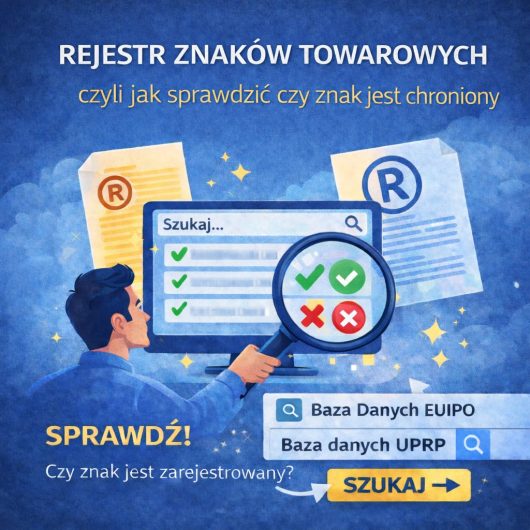
The register of trademarks is an official database containing information about registered and applied-for trademarks. It includes data on the owner, application number, scope of protection, classes of goods and services, and the status of the proceedings. In Poland, national trademarks are registered by the Patent Office of the Republic of Poland. At the European Union level, there is a system of EU trademarks managed by the European Union Intellectual Property Office. Each of these bodies provides public online search engines. The register covers both trademarks that have already n registered and those that are still in the process of being registered. This is important because even the application itself can pose a potential risk of conflict.
Registration in the CEIDG or KRS does not protect against trademark infringement. You can legally conduct business under a specific name, while simultaneously infringing on someone else’s intellectual property rights. The owner of an earlier trademark may demand that you cease using the mark, pay compensation, and even destroy materials bearing the disputed name.
Checking the register before starting your business helps you avoid costly rebranding and legal disputes. This is a preventive measure that often determines the long-term stability of your brand.
Also check: Free trademark search
The primary source for national trademarks is the publicly available register of trademarks, which is a search engine provided by the Patent Office of the Republic of Poland. For European Union trademarks, there is the EUIPO database, which covers protection throughout the European Union. There are also tools that integrate data from various registers, allowing for a broader analysis.
However, simply entering the name in the search engine is only the beginning. The interpretation of the results is crucial. Trademark protection is not limited to identical spellings. A similar visual, phonetic, or semantic designation may also be an issue, especially if it covers the same or similar goods and services.
When analyzing the results, it is worth paying attention to several elements. The status of the trademark is important – whether it is registered, applied for, or expired. Equally important is the scope of protection, i.e., the classes of goods and services. The same word can function in different industries without conflict, but within one category, the risk increases.
The date of application is also important. In trademark law, the principle of priority applies – an earlier application gives a stronger legal position.
The analysis should include not only identical marks but also similar variants, abbreviations, language variations, or other forms of writing.
It depends on the business plans. If the business is local and does not extend beyond the country’s borders, analyzing the national register may be a good starting point. However, in the age of e-commerce, even a small company often reaches customers in other countries.
The EU trademark provides protection throughout the EU market. This means that a conflict may arise from a registration made in another member state, even if the entrepreneur has never conducted business there.
Therefore, in practice, a safe check includes at least Poland and the EU system.
One of the common mistakes is limiting the analysis solely to identical names. Meanwhile, the law also protects against similar designations that may mislead consumers. Another mistake is omitting the classes of goods and services. The mere fact that a name exists in the register does not automatically mean a conflict – the scope of protection is key.
Entrepreneurs often focus solely on registered trademarks, ignoring pending applications. Meanwhile, the application itself may result in a later objection to a new trademark.
The trademark register is a public and very useful tool, but its analysis requires experience. Assessing the similarity of trademarks does not simply involve comparing letters. Sometimes, the difference of one letter does not eliminate the risk if the overall impression is similar.
Furthermore, there are prior rights that are not always visible in a simple search, such as unregistered marks with an established market position or company names.
Therefore, a professional trademark availability search includes not only checking the register but also analyzing the market context.
If an identical or similar mark covering the same industry appears in the register, it is worth considering changing the name even before starting business. In some cases, it is possible to conclude a licensing agreement or limit the scope of activity in such a way as to avoid conflict.
Ignoring an existing registration is a risky strategy. The owner of the earlier mark has the right to pursue their claims, and the dispute may result in a ban on the use of the mark.
Checking the register of trademarks should not be treated as a one-off action. In a dynamic business environment, new applications appear regularly. Monitoring the register allows you to react to potential conflicts already at the stage of publication of the application, when it is possible to file an objection.
For companies building a strong brand, the register becomes a strategic tool. It allows not only to protect one’s own rights, but also to analyze the activities of competitors and assess trends in the industry.
Summary
The register of trademarks is a public and accessible source of information that can protect an entrepreneur from serious legal problems. Checking whether a mark is registered should be one of the first steps in creating a brand.
The search itself is not technically complicated, but the proper interpretation of the results requires knowledge of the principles of trademark protection, the similarity of marks, and the scope of classes of goods and services. Conscious use of the register is the foundation for safe business development and investment in a brand that is to function in the market for years.
Fill out the form, and we will get back to you within the next 1-2 business days with a preliminary quote.