





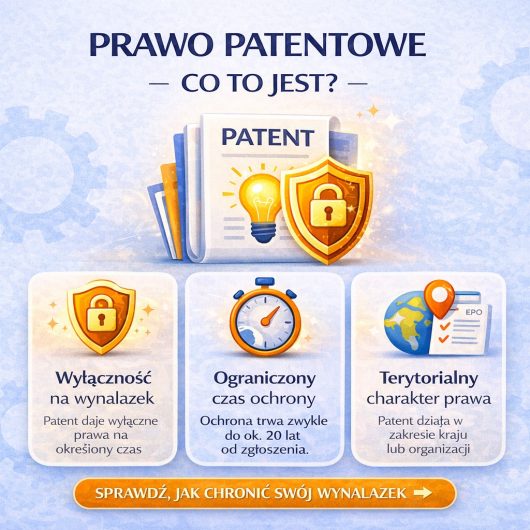
A patent is an exclusive right granted to an inventor or an authorized entity, which gives the right to exclusively use the invention for a specified period of time in a commercial or professional manner within the territory of a given country. It does not concern the protection of a general concept or idea. Patent law does not protect the “business idea” itself. It protects a specific technical solution – described in a precise manner and enabling its reproduction.
This is a very important distinction. Many people think that it is enough to “have an idea” in order to patent it. Meanwhile, the protection applies only to technical solutions that can be described in detail and their novelty demonstrated.
A patent is territorial in nature. This means that the protection only applies within the territory of the country or countries in which it has n granted. For businesses operating internationally, foreign procedures are important. In Europe, you can use the system managed by the European Patent Office, which allows you to obtain a European patent valid in selected countries. The choice of the appropriate strategy depends on the business plans, budget, and potential sales markets.
A patent grants the holder the exclusive right to exploit the invention for commercial or professional purposes. In practice, this means the ability to prevent other entities from manufacturing, using, offering, selling, or importing the protected solution.
The holder may also grant licenses, i.e., permission to use the invention in exchange for compensation. A patent can be sold, contributed to a company, or used as collateral for a loan.
The value of a patent often extends beyond mere protection against competition. It can increase the value of a company, build its credibility, and serve as an argument in negotiations with investors.
It is important to distinguish a patent from other forms of intellectual property protection:
For entrepreneurs, a patent is not only a right but also a business asset. A protected technical invention can:
Conscious management of the patent portfolio is also an element of the business strategy that can realistically affect the development of the project and its commercial prospects.
Patent law is a key element of the innovation protection system. A patent is an exclusive right granted for an invention, which protects the inventor from unauthorized use of their solution. This gives the inventor real legal tools to protect, exploit, and commercialize their technologies.
To obtain a patent, the solution must be new, inventive, and capable of industrial application. The patent application process is formal and requires careful preparation of the application. Protection lasts for a maximum of 20 years, after which the invention becomes public domain.
Knowledge of patent law principles is not only important for inventors, but also for any entrepreneur who wants to effectively protect and utilize innovations in the business world.
Fill out the form, and we will get back to you within the next 1-2 business days with a preliminary quote.

