



Znaki towarowe – zobacz jakie są rodzaje znaków i czym się różnią

Trademarks – see what types of trademarks exist and how they differ

Trademarks are one of the most frequently used, yet also most misunderstood, tools for brand protection. Many people associate them solely with logos, whereas in practice, a trademark can take on a completely different form, and the choice of its type has a real impact on the scope of protection, costs, and the effectiveness of enforcing rights.

What are trademarks, anyway?

Trademarks are designations that:

  • allow distinguishing the goods or services of one entrepreneur from others
  • can be presented in the register
  • are suitable for legal protection

The key here is distinction, not aesthetics or marketing. From a legal perspective, trademarks are intended to act as identifiers that clearly link the offer to a specific source.

Not every company sign automatically becomes a trademark. Only registration grants it full protection.

Why does the type of trademark matter?

The choice of trademark type affects:

  • the scope of protection
  • the ease of enforcing rights
  • resistance to oppositions and invalidations
  • brand development strategy

The same brand element can often be filed in several ways, but not every choice yields the same legal effect.

Trademarks - most common types

Word mark

A word mark consists exclusively of:

  • words
  • letters
  • numbers
  • their combinations

It does not protect graphics, font styles, or colors. It protects the sound and content of the name.

For example, if the name is written in a different font or in a different graphic layout, the protection of the word mark still applies.

Advantages:

  • the widest scope of protection
  • the greatest flexibility
  • easier enforcement of rights

Disadvantages:

  • more difficult to register for descriptive names
  • greater risk of conflict with prior marks


Figurative mark

A figurative mark includes only the visual element:

  • symbol
  • pictogram
  • drawing
  • a mark without verbal elements

The specific appearance is protected.

Advantages:

  • easier to register when the name lacks distinctiveness
  • a good solution for visual brands

Disadvantages:

  • narrower scope of protection
  • a change in graphics may require a new application


Word and figurative mark

This is the most commonly registered type of trademark. It combines:

  • name
  • logo
  • a specific graphic composition

The entire mark, as it was filed, is protected.


Advantages:

  • relatively easy to register
  • good recognizability
  • a compromise between the name and the graphics

Disadvantages:

  • a change in the logo may weaken the protection
  • does not protect the name independently of the graphics

Less common, but very important types of signs

Three-dimensional mark

A three-dimensional mark refers to:

  • the shape of the product
  • the shape of the packaging
  • a three-dimensional form

Protection applies to the three-dimensional form, unless it results solely from the technical function.


Color mark

A color mark protects:

  • a single color
  • a specific combination of colors

The condition is that the color:

  • is clearly defined
  • is associated with a specific source

In practice, this is a solution for brands with a very strong visual identity.


Sound mark

A sound mark is:

  • a melody
  • a sequence of sounds
  • a characteristic signal

It must be possible to clearly present it in the register, for example in the form of a musical notation or an audio file.


Positional and multimedia mark

A positional mark protects the way a mark is placed on a product, and a multimedia mark includes a combination of image and sound.

These are solutions used mainly by large brands, but it is worth knowing that such possibilities exist.

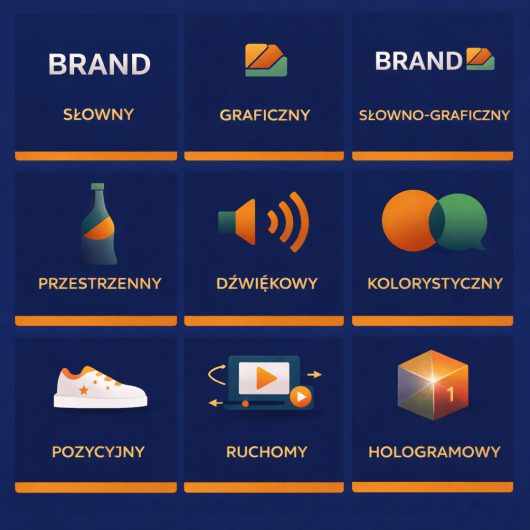
Examples of trademarks – see what you can register

Trademark Registration Strategy

A word mark offers the greatest flexibility, but it can be the most difficult to obtain. A word-graphic mark is easier to register, but less flexible. A graphic mark can be a good complement, but it should rarely be the only form of protection.

Therefore, in practice, a multi-layered strategy is often used, encompassing several marks at the same time.

Trademarks – the most common mistakes during registration

The most common mistakes include:

  • registering only the logo without protecting the name
  • registering a trademark that is quickly discontinued
  • lack of consistency between the brand strategy and the scope of protection
  • treating the trademark solely as a formality

Each of these mistakes can significantly limit the real value of protection.

Summary

The type of trademark determines what is actually protected, not just what is in the register. The choice between a word mark, a figurative mark, or a word-figurative mark is a strategic decision, not an aesthetic one.

There is no one-size-fits-all type of trademark that will work in every situation. Effective protection requires matching the form of the mark to the business model, development plans, and the way the brand is used.

A conscious choice of the type of trademark allows you to avoid gaps in protection, which often only become apparent when the brand begins to have real market value.

See how to check a trademark for free before registration

Table of contents:

You might also be interested in this:

Trademark register: how to check if a trademark is registered?
Trademark – find out what it is and how you can effectively protect it
Trademark cancellation – is it possible?

Share:

Facebook
Twitter
LinkedIn

Share:

Start character scan now

Fill out the form, and we will get back to you within the next 1-2 business days with a preliminary quote.

    Jaki znak mamy zbadać?


    Wybierz „znak słowny”, jeżeli chcesz zbadać oznaczenie słowne, i wpisz je w okienku poniżej. Możesz podać tylko jedno oznaczenie.
    Wybierz „znak graficzny lub słowno-graficzny”, jeżeli Twój znak ma określoną postać graficzną. W okienku poniżej wpisz elementy słowne, jeżeli takie pojawiają się na grafice, i dodaj plik zawierający grafikę znaku. Możesz przesłać tylko jeden plik o maksymalnym rozmiarze 1mb.

    Podaj szczegółowo, dla jakich towarów lub usług będzie używany Twój znak. W okienku poniżej wyszukaj odpowiedni termin, a następnie kliknij na niego, by dodać towar lub usługę do listy. Możesz dodać jednocześnie wiele towarów lub usług. Przed przejściem do następnego kroku upewnij się, że na liście znajdują się wszystkie towary lub usługi – później nie będzie można jej zmodyfikować!

    jakich produktów lub usług dotyczy rejestracja