





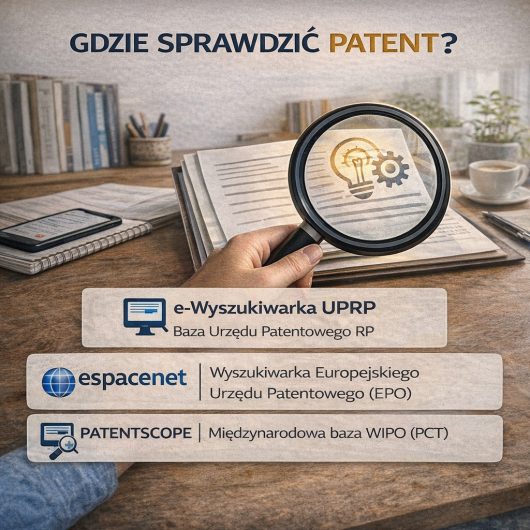
A patent is an exclusive right granted for an invention that meets certain criteria, such as novelty, inventive step, and industrial applicability. In Poland, the Patent Office of the Republic of Poland grants exclusive rights in the field of patents. At the European level, there is a system managed by the European Patent Office.
Checking a patent can mean several things. You may want to find out if a specific solution is already protected. You may also want to determine whether a particular patent is still in force, who owns it, or what the scope of protection is. Each of these goals requires a slightly different analysis, but the starting point is always public patent databases.
The primary source of information on national patents is the database provided by the Patent Office of the Republic of Poland. The registers are public and available online. You can search for applications and granted patents by number, invention name, inventor’s name, or assignee.
The database contains data on the legal status, filing and grant dates, as well as information on the expiration of the patent. This is particularly important because a patent does not last forever.
When seeking protection covering multiple European countries, it is worthwhile to use the tools provided by the European Patent Office. This system allows you to search for applications and patents in force in various countries.
In practice, many innovative solutions are filed under the European system, so analyzing only the Polish database may prove insufficient. If you plan to introduce a product to the international market, checking the protection in a broader scope is crucial.
The most common reason is the desire to ensure that the planned solution does not infringe on the rights of others. Introducing a product covered by someone else’s patent to the market can have serious consequences, including claims for damages and an injunction against sales.
Another reason is to analyze the competition. Patent databases are a huge source of technical knowledge. They allow you to understand the directions of industry development, the innovation strategies of companies, and the scope of protection they choose.
Often, checking a patent is also part of preparing for one’s own application. In order to obtain a patent, the invention must be new on a global scale. Therefore, before filing an application, a prior art search is carried out, which includes an analysis of previous patent publications.
In the age of globalization, the answer is usually no. A patent is territorial in nature, meaning it is only valid in the territory in which it is granted. If you plan to export or manufacture in another country, it is worth checking whether a patent covering your solution is in force in that country. In practice, this means analyzing international patent databases.
Technically, yes. Patent databases are public and freely available. Searching by keywords, patent numbers, or inventors’ names is not complicated.
The difficulty arises at the interpretation stage. Patent documents are written in technical and legal language. Understanding the scope of protection requires precise analysis and experience in working with this type of documentation.
Therefore, in the case of significant investments or projects with high market potential, it is worth considering a professional examination by a patent attorney.
The answer to the question of where to check a patent is relatively simple: in public registers maintained by the relevant patent offices, both national and international. However, what is much more important is why you are doing it.
Checking a patent allows you to assess whether a given solution is protected, whether the protection is still valid, and what its scope is. This is an action that protects against infringement of third-party rights, supports competitive analysis, and forms the basis for conscious innovation management.
See more: How much does a patent for an invention cost and how long do you have to wait for it?
Fill out the form, and we will get back to you within the next 1-2 business days with a preliminary quote.

